HMAS Castlemaine, a video story
HMAS Castlemaine played a vital role in protecting Australian waters during World War II, conducting patrols, escorting convoys, and engaging in anti-submarine warfare. She also participated in the New Guinea and Timor campaigns, providing support to Allied forces in the region.
After the war, Castlemaine was used as a training ship for the Royal Australian Navy Reserve until her decommissioning in 1945. She was then transferred to the Maritime Trust of Australia and underwent restoration to become a museum ship. Today, visitors can explore the ship and learn about her history and the role she played in defending Australia during wartime.
HMAS Castlemaine stands as a reminder of the bravery and sacrifice of the sailors who served on her during World War II, and is a valuable piece of Australia’s naval heritage.
HMAS Castlemaine: The Guardian of Australia’s Maritime Heritage
Built during a period of existential threat to Australia, HMAS Castlemaine (Pennant number J244) remains one of the most significant surviving symbols of Australia’s naval defenses during World War II. As one of 60 Australian Minesweepers—commonly known as Bathurst-class corvettes—constructed between 1940 and 1944, Castlemaine served as a versatile workhorse for the Royal Australian Navy (RAN). From escorting supply convoys across submarine-infested waters to conducting frontline support in the Timor and New Guinea campaigns, her service record embodies the tenacity and sacrifice of wartime sailors.
Today, preserved by the Maritime Trust of Australia as a museum ship, Castlemaine stands as a living historical monument docked at Gem Pier in Williamstown, Victoria.
Construction and Early Deployment
The Bathurst-class corvettes were designed as Local Defence Vessels (LDVs) to meet the Royal Australian Navy’s rapid expansion needs at the onset of World War II. Designed to be relatively inexpensive and straightforward to build in domestic shipyards, they filled roles in anti-submarine warfare, minesweeping, troop transport, and escort duty.
Castlemaine was laid down on February 17, 1941, at the Williamstown Naval Dockyard in Victoria. Her launch on August 7, 1941, provided an unusual moment in naval history: extreme cold weather hardened the slipway tallow, leaving the vessel stuck until pulled into the water by the tugboat Keera. She was officially commissioned into service on June 17, 1942, under the command of Lieutenant Commander Philip J. Sullivan.
| HMAS Castlemaine Specifications | Detail |
| Class & Type | Bathurst-class Corvette / Minesweeper |
| Displacement | 650 tons |
| Length & Beam | 186 feet (56.7 m) × 31 feet (9.4 m) |
| Speed & Complement | 15.5 knots (28.7 km/h); 85 officers and crew |
| Armament (Wartime) | 1 × 12-pounder 12 cwt naval gun, Oerlikon anti-aircraft guns, depth charges |
Detailed records of her construction and design specifications are maintained by the Royal Australian Navy Sea Power Centre.
World War II Operations: Convoys and Anti-Submarine Patrols
Immediately following her shakedown cruise and trials off Broken Bay, Castlemaine was thrown into active duty guarding shipping routes along Australia’s eastern coastline. During mid-1942, Imperial Japanese Submarines (such as I-21 and I-27) actively targeted Allied merchant vessels in Australian coastal waters, making convoy defense critical to national security.
Castlemaine carried out high-risk patrol and escort missions between Sydney, Melbourne, and Townsville. Using ASDIC (sonar) equipment and depth-charge throwers, her crew monitored underwater contacts to prevent axis forces from severing the vital supply arteries connecting Australian ports to northern forward operational bases.
By late August 1942, Castlemaine transferred north to Townsville to escort vital troop and supply transports running up to Port Moresby, Papua New Guinea.
The Top End, Timor, and New Guinea Campaigns
In October 1942, Castlemaine relocated her operational base to Darwin. Operating in northern waters exposed the corvette and her crew to frequent aerial bombardment by Japanese aircraft based in the Dutch East Indies (now Indonesia).
The Timor Resupply Operations
During late 1942, Castlemaine participated in hazardous resupply and evacuation missions to Timor, supporting the “Sparrow Force” guerrillas operating behind enemy lines. In late November and early December 1942, Castlemaine worked alongside her sister ships, HMAS Armidale and HMAS Kalgoorlie, to land Dutch and Australian troops while rescuing stranded civilians and wounded soldiers.
During these operations on December 1, 1942, Japanese air attacks struck the force, resulting in the tragic loss of HMAS Armidale. Castlemaine engaged attacking bombers and fighters with her anti-aircraft weaponry, dodging multiple bomb runs and providing crucial anti-aircraft coverage in dangerous, enemy-controlled seas.
Survey and Pacific Fleet Duties
As the tide of war shifted, Castlemaine’s role evolved:
Hydrographic Survey Work: Beginning in August 1944, Castlemaine surveyed uncharted waters along Australia’s northern coastline to map safe navigation channels for Allied warships.
Philippine & Pacific Operations: Moving further north, she supported operations around Morotai and the Philippines.
Japanese Surrender & Minesweeping: Following the cessation of hostilities, Castlemaine arrived in Hong Kong on August 29, 1945. She stood present during the official Japanese surrender ceremonies and immediately set to work clearing minefields across northern waters before returning home to Australia in November 1945, having logged over 117,000 operational sea miles.
Post-War Training Role and Decommissioning
After four years of continuous war service, Castlemaine paid off into reserve status at Melbourne on December 14, 1945. However, her service to the Royal Australian Navy was far from complete.
In 1958, following a comprehensive refit, Castlemaine was towed to the shore establishment HMAS Cerberus at Westernport, Victoria. There, she served as a stationary training ship for engine-room artificers and the Seamanship School. For over a decade, junior sailors learned engine maintenance, anchor handling, and seamanship fundamentals aboard her hull.
By 1971, after decades of military duty, the Navy declared Castlemaine surplus and slated her for disposal.
Restoration and Preservation as a Museum Ship
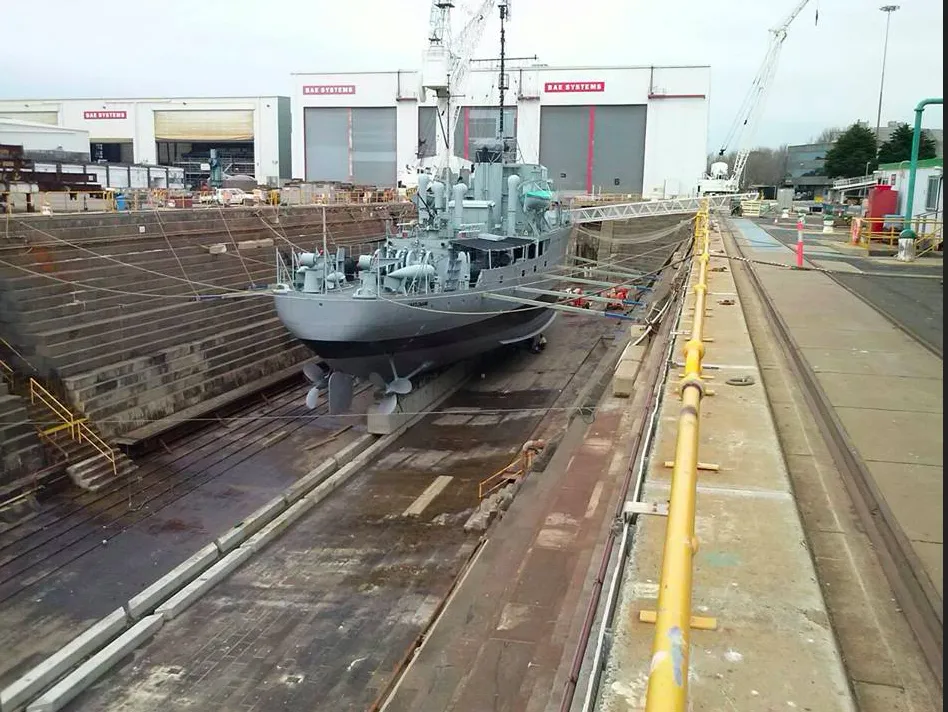
Rather than being scrapped, Castlemaine was gifted to the Maritime Trust of Australia in 1973. She was towed back to Williamstown—just meters from where she had been constructed 32 years earlier—where a dedicated group of volunteers began an extensive restoration project.
Over decades, volunteers restored her 12-pounder main gun, anti-aircraft mountings, twin triple-expansion steam engines, bridge gear, and crew quarters to their authentic wartime appearance. Recognised for its historical integrity, the ship was formally listed on the Victorian Heritage Register in 2020 by Heritage Victoria as the state’s last intact Second World War warship.
Visitors can board the ship at Gem Pier on weekends and public holidays to tour the engine room, wheelhouse, mess decks, and radio room. Further details on visiting schedules, volunteer efforts, and educational resources are accessible via the HMAS Castlemaine Official Website.
Naval Heritage Legacy
HMAS Castlemaine serves as an enduring memorial to the thousands of Australians who served aboard Bathurst-class corvettes during the Pacific War. As one of only two surviving Bathurst-class vessels in Australia (alongside HMAS Whyalla), she bridges the gap between past and present, offering future generations an immersive glimpse into wartime maritime life.